

According to tradition, St. Vitus would be born in Mazara del Vallo from Hila of noble birth but not a Christian, and White , virtuous matron, devoted to Christ, around the year 286. Lost his mother as an infant, and was entrusted to the nurse Crescentia .
It is said that when the twelfth day after birth, the father Hila wanted to attack the baby's neck bulla, which is a medal with the effigy of the Penati (patrons) of the house, the infant began screamed and tore the neck quell'amuleto pay throwing away.
Crescenzia accepted instead a cross that had put the neck of his father's hidden, and received a buon grado gli insegnamenti Cristiani impartitigli dalla nutrice.
Quando Vito fu un po' cresciuto, suo padre gli diede come precettore Modesto , uomo saggio e dotto di Mazara, affinché lo istruisse nelle lettere e nelle scienze: ma anche questo pedagogo era cristiano. Durante un'assenza del patrizio Hila, molti del suo palazzo si convertirono e ricevettero il battesimo da Modesto: primo fra tutti fu il giovanetto Vito. Si narra che a questi, appena battezzato, sia apparso il suo Angelo custode che gli consegnò una croce, come presagio del suo martirio: attributo che accompagnerà sempre le raffigurazioni del Santo.
Il 23 febbraio del 303 fu emanato, Emperor Diocletian, the edict of persecution against Christians, and while the stately residence is spread the new religion came to Mazara the fatal imperial decree. Back Hila, venutone aware, did not neglect any means, nor severe punishments, or threats to frighten the child and get him to recant their religion in his absence, but nothing was enough to shake the unshakable faith of the adolescent. Then the cruel parent, since any attempt futile, surrendered the child to the prefect of Sicily Valeriano asking him, with his authority, Vito bring back the cult of the empire.
He ordered the young man was subjected to flogging, but suddenly, while the executioners incited by Valeriano, destroyed them innocent members, here is that their arms are paralyzed and only for the prayers of Vito, returned to move the limbs. Only then can the cruel tyrant sent to the Holy Father's house. However, an angel of the Lord appeared in sleep to S. Vito and invited him to flee their homes and seek refuge with his teachers, at night, on a boat moored on the shore for divine favor. Guided by the Angel in the form of pilot, sailed to Cape Egitarso, now Cape St. Vito, where he took refuge in a forest and began their evangelizing apostolate shepherds and farmers, as well as performing miracles of healing those who was bitten by rabid dogs. Then the three went to saints Regalbuto, in Sortino, in Vizzini, in Calabria and Basilicata in the Sele River and their miracle-working reputation spread so quickly were found by soldiers of the emperor who brought them to Rome.
S. In the eternal city Vito cured by none other than the daughter of Emperor Diocletian, who gliel'avrebbe also given in marriage filling him with honors, provided, however, that abjure the Christian faith.
View all vain flattery, the emperor ordered that the three saints were plunged into a cauldron of boiling pitch and molten lead, but by their martyrdom came out unscathed. They were then conducted in the amphitheater and fed to rabid dogs and lions, who tamed stretching at the foot of Vito. The emperor was extremely angry because the crowd of spectators began to stir, he commanded to put the three confessors of the faith on a pyre, so consumed by their martyrdom: 15 June of the year was 304. The remains of the three Saints were then collected in secret by a noblewoman: Fiorenza Princess of Salerno.
She was rescued from a storm on the river Sele. While he appeared to drown, by the will of God, St. Vitus, which released her from danger. The Princess, the miracle grateful received, made a vow to St. Vitus and his Companions to guard their bodies. She was committed to moving their bodies for a dignified and honorable burial in a place called "Locus Marianus" allocated in Puglia, in conformity with the desire of the saint. The princess asked him during a dream, where was that place and San Vito said: "At a time Castrum Polymnianense destroyed by the army of Julius Caesar."
Donna Fiorenza, therefore, bought some land which he donated to the Benedictine monks who were then in that place because it houses the remains of the saint. That place where now stands the ' Abbey of St. Vitus in the territory of Polignano a Mare (ancient Castrum Polymnianense).

Statue of St. Vitus, in the church of San Michele in Mazara del Vallo
The saint's relics are located in Prague, in the cathedral dedicated to him
(I took the following photos during a trip)


Piazza della Repubblica

Valuable statue, commissioned by Bishop Michael Sclavo (1766-71). Work of Ignatius Marabitti Palermo (1771). The inscription says: Divo Vito, et civic patron, benificentissimo - Michele Sclavo - Mazar - Pontificex. On the other side: Hic est, multum orat here - pro populo - civitate et universa
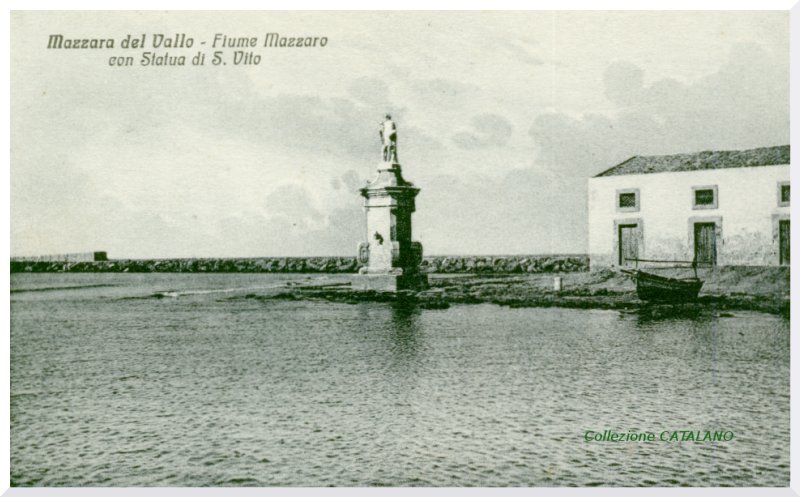
Monument place at the mouth of the river Mazaro, by Joseph Pennino (disciple of Marabitti), commissioned by the Bishop of Valdina, Hugh Pape (1772/91). Bears witness to the faith and devotion the people to supervise the fellow from the sky, pray and ensures reliable protection. Four couplets, at the four sides of the pedestal read as follows: At the front of the city
Sint Procula fluctus hinc, inde fit Procula tremor.
(Protector of the sea and protector of the earth, which dominates both
are by far the waves here and be here, far from fear)
On the right side, in view of the sea, praising the saint as the liberator of the enemy armies and pitfalls of Satan,
This beautiful beast premunt Patriam, Cruce lose Phalanges
Et Satanae turbas you Cruce, Dive, escape.
(If cruel wars oppress the country, you with the Cross disperse
phalanges and the Cross, or Healer, put to flight the armies of Satan)
The left side is praising the Holy One, as the liberator of hunger:
It hurt Suada fames siculas grassatur in Urbes: You
Joseph Patriae, dive, Dabis feeds
(If hunger , a bad counselor, advancing towards the Sicilian city
You, like Joseph, or patron, give us bread)
In the back of the statue praising the Holy One, as the liberator of the plague:
It pestis coelum minitatur, Dive, plagues a country you Procula
Hoc quoque skin malum
(If the sky is threatening us with the plague, or protector,
keep away from here even this evil).
located inside the city is also the church of San Vito in urbe, that then the church of Santa Teresa. A pious tradition considers la chiesa costruita dove fu l’antica abitazione di San Vito. Una lapide ne tramanda la memoria: “Hanc habui, nec linquo domum; vos plaudite cives: sum patriae, custos, gloria, vita, decus” . La chiesa fu fondata dalla confraternita di San Vito, il sodalizio che annoverava tra i soci della confratria buona parte della nobiltà mazarese. Questa confraternita, istituita il 25.03.1588 con propri capitoli, fu approvata dal vescovo Luciano de Rubeis (1589-1602) e vide riformate le sue costituzioni l’8.06.1778 dal vescovo Ugone Valdina Pape (1772-1791). The Brotherhood ensured the cult of the saint in the city and was required to encourage more and more clergy and laity in new forms of worship and religion in the public and private sectors.


0 comments:
Post a Comment